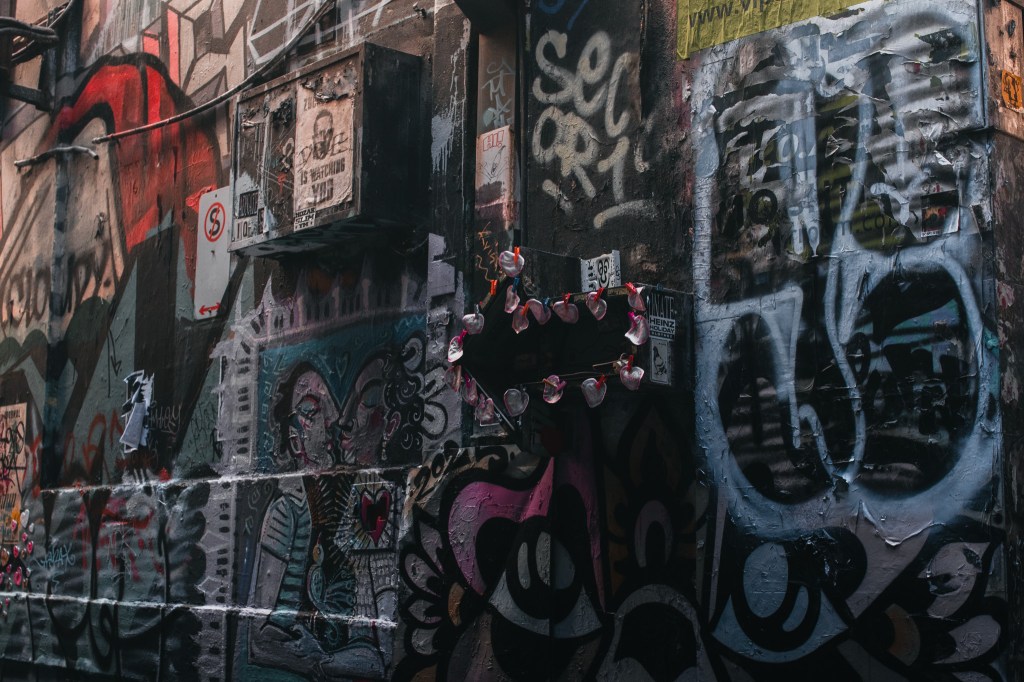
Image of a graffitied alley in Melbourne CBD taken by me
Australia is Culturally and Ethnically Diverse
The city of Melbourne (pronounced as Mel-bin) has one of the largest Asian populations (India and China among the top countries represented) of any other city in Australia, besides Sydney. As a result, these groups have played a significant role in shaping Australia’s culture as we know it today. In fact, the culture here is an amalgamation of all the different groups that have immigrated to or originated in the country. Growing up, I became accustomed to being part of a minority group (Chinese) in my hometown. So, seeing people who look similar to me dominate certain suburbs is something I never thought I’d experience again. At the same time, there are moments when I feel like I don’t belong, due to my lack of knowledge of my own culture and the disconnect I feel from it. As sad as that may sound, I’m grateful for the unique and positive upbringing I had as a child. One of my goals while abroad is to learn more about my culture and share it with my friends and family back home. Aside from the Asian groups, there are plenty of other groups that have also influenced Australia’s culture, for instance the British, as it was once colonized by them until they declared independence in 1906. Their influence can be seen in some aspects of their everyday lives such as driving on the left side of the road and adopting words commonly used in England (i.e. cookies, chips, trousers, trolley, etc.). That said, another significant group in Australia is the Indigenous people, often referred to as the First Nations peoples (The Aboriginals and the Torres Strait Islanders).
A complete culture shock to me when I first arrived was the Acknowledgement to the country. It is a tradition where people (typically in gatherings, but you may find it at the very bottom of websites originating from Australia) make an acknowledgement to the country, which pays tribute to the traditional custodians of the land that the gathering is being held upon. It reinforces the connection between the people and the country and planet we inhabit. For the curious minded people, Deakin university’s Burwood campus (the campus i’m at) resides on the traditional lands of the Wurundjeri people of the greater Melbourne (Naarm) region. For more information, here’s a link to a website that probably does a much better job at explaining it than I can. Now to other aspects of Australian culture and their ways of life, starting with shopping.
What’s it like shopping in Australia, at least in Melbourne?
The shopping culture here is incredibly eco-friendly. What do you mean by eco-friendly you might ask? Well, for starters, single use plastics are being phased out in Australia with some states implementing total bans (Victoria included). Meaning, plastic utensils, straws, and food containers are now/have been replaced with eco-friendly alternatives such as wooden utensils, paper straws, and cardboard containers. Secondly, most shoppers bring their own reusable bags or something equivalent. If a shopper doesn’t have any reusable bags or because they forgot, they have the option to purchase bags from the store, either reusable ones or paper bags, all of which costs extra (I paid 25¢ for one bag, but the price may depend on the store).
What I don’t like about shopping in Melbourne is that 90% of the registers are self-checkout and only accept cards. I personally prefer having a cashier scan my items instead of doing it myself. I get stressed and feel rushed when there’s a line of people behind me, and it doesn’t help when there’s a camera watching my every move. Another thing I have to keep in mind is how much do I plan on buying? As an international student, I don’t have the luxury of getting a lot of stuff at once given I don’t have a car to store stuff. I have to be more methodical and think, can I transport everything back? Not to mention the closest tram stop is a 15-minute walk from where I live. I really wish there was a stop closer, but hey at least I have the option of using public transit.
What kind of shops are there?
There are TONS of shops everywhere. Melbourne’s CBD is packed with stores and restaurants from all over the world. From name brands to local gems, it is a great way to find souvenirs or goods all within walking distance from one another. What’s great is that the trams in the CBD area are free to use. It’s definitely worth checking out if you find yourself in Melbourne. Outside of the CBD, there are plenty of malls and shopping centers throughout the suburbs.
Now, when it comes to getting groceries, there are two major grocery store chains in Australia, Woolworths (gives off whole food vibes) and Coles (Publix equivalent). I personally prefer Coles over Woolworths. I feel like Coles offers more options and is slightly cheaper (I haven’t actually compared the prices, but it feels cheaper). Most of the stores for both chains are located in malls (at least the ones in urban/suburban centers), but there are stand alone stores in more rural communities. In addition to Coles and Woolworths, Asian markets can be found in almost every block. Well… maybe not every block, but I see them as frequently as McDonalds if that says anything. I thought Lynn’s Oriental market in Tallahassee was the best Asian market out there, but since coming to Australia, it is not comparable to the stores here. The Asian stores here are enormous (about the size of one of Walmarts neighborhood markets) and they offer a wide range of products, from produce and snacks to frozen goods, sauces, and spices. They basically have everything, and their prices are relatively cheap. I also forgot to mention that Australia has Kmart! Though I’ve been let down by them several times. What I find most entertaining is that some of the stores here have been rebranded/renamed after stores found in America:
- Bed Bath and Beyond = Bed Bath N’ Table (Guess the beyond part was too open ended? Technically this is an Australian owned company, but it’s basically Bed Bath and Beyond)
- Burger King = Hungry Jacks
- T.j. Maxx = T.k. Maxx
Note, there are plenty of American stores in Australia such as Target and Costco, including stores dedicated to selling American goods (I haven’t had the chance to go into one, but maybe in the future).
Australians love shortening words or abbreviating them. Here’s a list of some I’ve heard being used:
- McDonalds = Maccas
- Woolworths = Woolies
- Australia = Straya
- Australians = Aussies
- Melburnians = Melbs
- Tasmania = Tassie
Some less impressive moments of living in Australia.
- Prior to coming to Australia, I knew that people drove on the opposite sides of the road, but what I wasn’t expecting is that people also walked on the other side. They can probably spot that I’m a foreigner just based on which side of the sidewalk I’m on.
- The other day I heard crikey be used in a sentence and I immediately thought of the TV show Crikey! it’s the Irwins.
- In my previous blog I briefly mentioned how affordable it is living here, and while that’s mostly true, there are some exceptions:
- Alcohol, but mainly beer
- Cheese – I don’t know why but I feel everytime I look at their cheese prices, they seem pretty steep. Good thing I don’t eat cheese
- Public Transit – It is surprisingly expensive to use their public transit system. One tram ride is $5.50 AUD (~$3.50 USD) whereas a bus ride is $3.50 AUD (~$2.25 USD). While that doesn’t sound like a lot, it adds up overtime. I recently ordered a 90 day international student pass that gives me a 50% discount each time I use public transportation. The cost of ordering that special card was $297 AUD (~$190 USD) and it takes 3 weeks for it to be shipped to me, so I better get my moneys worth.
Recent Events
Recently, Cyclone Alfred (a hurricane, as we call it in the U.S.) made a rare landfall along the east coast near Brisbane and the Gold Coast. It’s the first time in five decades a storm this strong has made landfall this far south. Most people in those regions have probably never experienced a weather event like this before in their lifetime. It’s fascinating seeing the mixed responses from Aussies. Some have taken advantage of the high surf to go surfing, while others have been sliding down hills with boogie boards in the rain. I’ve heard comments that Aussies don’t take anything seriously, which seems to be true in this scenario. I haven’t come across anything about cyclone parties, but I wouldn’t be surprised if some people did that.
Tapping into my inner meteorologist, I discovered Australia has a different way of measuring hurricane intensity compared to the Saffir-Simpson hurricane wind scale used in the North Atlantic and Eastern Pacific Oceans. They still use a category system, but their wind speed scale is weaker. For example, their category 1 cyclone is equivalent to a tropical storm in the U.S. So, theoretically, Cyclone Alfred (a category 2 cyclone according to the Australian intensity scale) unleashed tropical storm or weak category 1 hurricane like conditions, which for me is a walk in the park. Nevertheless, I hope the areas affected by Cyclone Alfred did not sustain any significant damage.

 The Traveling Jade
Leave a comment