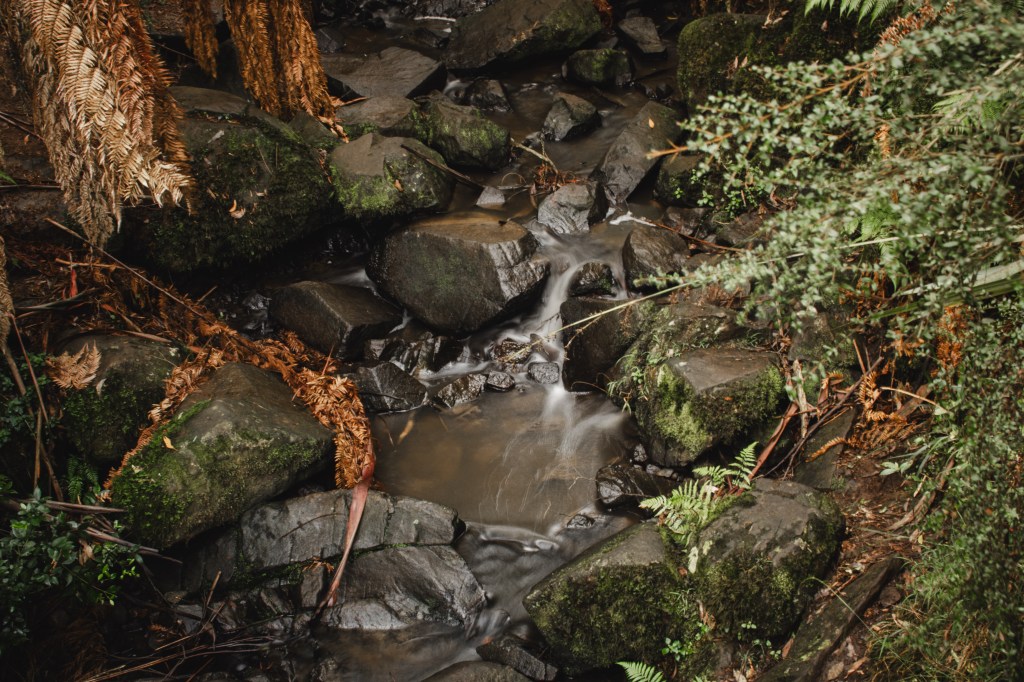
Image of a creek flowing downstream from Sherbrooke Trail in The Dandenong Ranges National Park
One of the biggest questions I’ve been asked before and after arriving in Australia is, “of all the places in the world, why did you choose to study in Australia?” To preface, a year ago, I didn’t think I’d actually end up in Australia. What started as a spontaneous “what if” scenario turned into reality.
To start, one of the reasons I chose Australia was because of its exotic wildlife. Most people I know would choose not to go because of the wildlife. While Australia does have some of the world’s deadliest and poisonous animals out there, the odds of encountering them in the wild are fairly slim. In my 1.5 month stay so far, the only dangerous animal I’ve encountered so far was a Redback Spider (dubbed as the Australian black widow). Even then, I wasn’t scared, because like most animals, they don’t attack unless provoked.
The other more significant reason for choosing to study here, is that I want to gain new skills and perspective on conservation and wildlife management. As someone who is potentially going into a career in this field, having these perspectives allows me to take on different approaches. Despite the deadly animals that steal the spotlight, people tend to forget that Australia is recognized for its endemic fauna and flora. Because of this, it also has the highest extinction rate in the world. In efforts to preserve these organisms, they have implemented some of the most extensive and strictest conservation policies in place like the Environment Protection and Biodiversity Conservation Act 1999 (EPBC Act). Another example is the 30 by 30 target where the government aims to conserve 30% of its land and 30% of its marine areas by 2030 (DCCEEW, 2024). Currently, more than 22% of its land (including inland waters) is protected (DCCEEW, 2024), compared to just 12.9% in the United States (USGS, 2021).
It is truly an honor to study abroad and gain experiences that I otherwise would never have had at my home university. It’s also special to have the opportunity to see and encounter species that may go extinct in the next decade or century. I hate to leave things on a depressing note, but this is the unfortunate reality of what that were facing.
References
USGS (2021), Analysis of updated USGS database finds increase in America’s lands and waters managed for biodiversity, https://www.usgs.gov/news/technical-announcement/analysis-updated-usgs-database-finds-increase-americas-lands-and-waters.
DCCEEW (2024), Pathway to protecting and conserving more of our precious land by 2030 https://www.dcceew.gov.au/about/news/pathway-to-protecting-conserving-more-precious-land-by-2030
DCCEEW (2025), Environment Protection and Biodiversity Conservation Act 1999 (EPBC Act) https://www.dcceew.gov.au/environment/epbc

 The Traveling Jade
Leave a comment