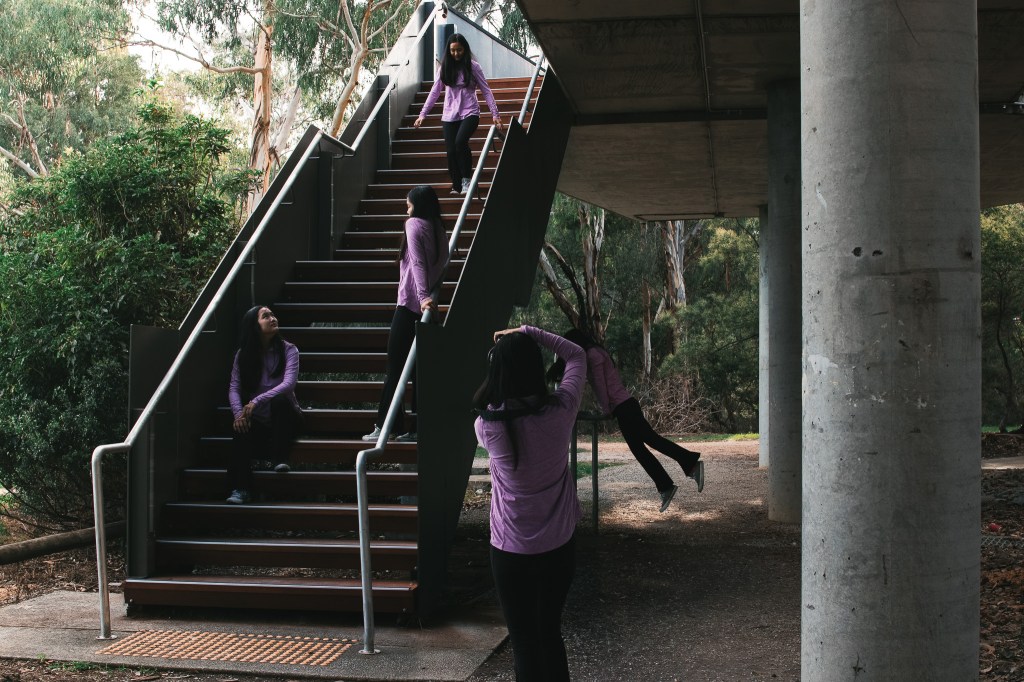
Doppelgänger photo exercise from my digital photography class
A question many of you might be wondering is: what was it like studying at my host university, Deakin University, and how does it compare to my home university, New College of Florida?
Campus
I consider Deakin University a large institution, with four main campuses: Warrnambool, Geelong Waurn Ponds, Geelong Waterfront, and Melbourne Burwood (the largest), along with a few international locations. I studied at the Burwood campus, though I did consider one of the Geelong campus campuses because they offered more interesting biology and environmental science courses like Introduction to Zoology. Ultimately, I chose Burwood in hopes of having a more authentic study abroad experience since it was relatively close to the city.
Courses/Units
Deakin University offers a wide selection of courses or units as they call it. My course selection was primarily based on what would count toward my undergraduate degree, as well as whether it was something unique that I couldn’t take at my home university. I enrolled in four units, which was barely enough to be considered a full time student.
- Environmental Techniques and Monitoring
- Ecology and The Environment
- Biodiversity: A Global Perspective
- Digital Photography
Class Structure
One of the most interesting aspects of my study abroad experience was the way classes were structured. I had expected it to be different only by a little, but not this much. All of my classes had at least two instructors, some more than others (usually for practicals) which turned out to be pretty efficient. With roughly 30,000 students at the Burwood campus alone, most of my classes had over 100 students enrolled. Having multiple instructors made scheduling more flexible and allowed for more available time slot in our timetables.
Typically, lectures were held twice a week (one hour each), with a practical session once a week Unfortunately, most of my classes held lectures online via zoom, which limited opportunities to engage with my peers. That said, the online format made things flexible, especially for students who lived far from campus.The practicals on the other hand were always in person and were by far what I loved most about Deakin. It was an opportunity to apply lecture content in real-world scenarios, which often laid the groundwork for upcoming assignments. My Environmental Techniques and Monitoring class had the most practicals with usually one every week, while Biodiversity and Ecology courses had one every other week or once a month, which was still more than what I was used to at New College. For my Digital Photography class, there wasn’t a designated practical, but we often had time during seminars to complete photo exercises.
Because of all the practicals plus lecture classes, it resulted in me having a sporadic schedule. Every week was different, some weeks I would have Friday off, while others I would get both Friday and Thursday off or none, not to mention the meeting location would also be different. Despite the inconsistent weekly schedule, Deakin is incredibly organized. I just discovered that they have already published approved academic calendars through 2028. In addition, before course registration comes along, the course catalogue for each study period lists all assignments for each unit making it easier to gauge course load and difficulty of each unit.
Homework
At Deakin, each of my courses typically included three to four assignments throughout the teaching period, plus an End of Unit Assessment (EoUA). At first glance, it seemed like it was less work than New college, and that may be true for some units. However, the catch was that each assignment was worth a significant portion of your overall grade. This meant that if you did poorly on one, it could have a major impact on your final grade.
Assignments were also graded with extreme attention to detail, and marks could be taken off for any given reason. For example, in my Environmental Techniques and Monitoring class, I needed to illustrate a soil profile for a part of an assignment. It needed to include soil horizons, scale, titles, pH values, and a legend. I did all that except the legend as I was unsure of how to include it. I had already labeled each layer, and I hadn’t used any symbols or figures that would typically require a legend. Long story short, they docked points off because I was missing a legend. Even though New College is an Honors college, I’ve found the grading to be less rigorous in comparison. In that sense, the coursework there sometimes feels a bit easier.
One of the most surprising differences I encountered was Deakin’s grading system. Instead of the traditional letter grades (A, B, C, D, F), they use a different scale:
- HD (High Distinction) = >80%
- D (Distinction) = 70% – 79%
- C (Credit) = 60% – 69%
- P (Pass) = 50% – 59%
- N (Fail) = <50%
It definitely took some adjusting, since I’m so used to traditional letter grades. So seeing scores that are 75% to me seemed poor, but for Deakin that’s considered good. The instructors at Deakin are always respectful and provide detailed feedback on what parts were good and which parts to improve.
Campus Life
The campus life at Deakin is incredibly diverse and engaging. Students and staff are all about providing support for one another and are constantly promoting resources and services. I’m not surprised about that, after all, the school is a hotspot for international students. Before the first week of classes, they have their orientation week which they dub as O-week, and basically It’s a event where local businesses and university organizations introduce new and returning students to their services. These vendors include local banks, phone plan providers, library services, the student association, clubs, and more. It’s also a great opportunity to meet people, ask questions, and grab some freebies.
The other side to campus life is Res life. As someone who lived on campus, I found residential life to be vibrant and active. There were typically two to three events each week, ranging from rock climbing and weekend trips to animal encounters and fortnightly events like game night. I participated in a few activities earlier in the trimester, but as time went on, I stopped attending events due to lack of availability and because the people I usually went with stopped communicating with me. Still, from the events I did attend, they were enjoyable and offered a great way to meet fellow students.
The one complaint I suppose would be the actual on-campus accommodation itself. I was given a shoebox-like room within a four-person apartment style dorm. The apartment included two bathrooms, a shared living space, and a full kitchen. Fortunately, there were only four of us (rather than the maximum six), which was a relief given how cramped the kitchen felt. I enjoyed being able to cook my own meals, but not the grocery shopping. My one constant paranoia was setting off the fire alarm, which came at a $3,000 AUD fine if triggered. The location of the apartment could have been better. Being situated on the 2nd floor (3rd if you include ground floor) had its pros and cons. I always felt like I was stalking the people beneath overhearing their conversations as they passed by since it faced the main courtyard. That said, being so close to the courtyard made attending events convenient since it was just a short walk down the stairs. As for my roommates, I’d say we became good acquaintances. We had a few conversations here and there, but never really hung out. Personally, I still count that as success compared to my previous roommate experience at New College, where we coexisted in total silence.
To conclude, studying in Australia has been an amazing opportunity and I would definitely encourage anyone who is interested in studying abroad to pursue it. Of course it had its ups and downs, but that’s part of the experience. In the end it builds character, challenges you in new ways, and you get to look back and be able to say that you were able to live on your own halfway across the world. A year or two ago, I never would have imagined myself doing something like this. I’m proud of myself and my friends and family who encouraged me to pursue this adventure. I have grown so much from it, and I hope to share these experiences with others and maybe one day I’ll find myself back in Australia either for further studies or for holiday.

 The Traveling Jade
Leave a comment